KitchenAid mixer motor runs but the beater won't turn: what it means
By Alex at MixerFixer, Vaughan · Updated November 22, 2026
The short answer
Unplug it. When the motor runs but the beater will not turn, the fault is usually in the gears. If the front attachment hub has stopped as well, the likely cause is a stripped worm gear, and that is my full tune-up at $175 on any mixer. If the hub still turns, the worm gear is probably fine and the planetary or its pin is more likely, so start with the $40 diagnostic. A motor that only hums may be jammed or have an electrical fault, so leave it unplugged and have it checked.
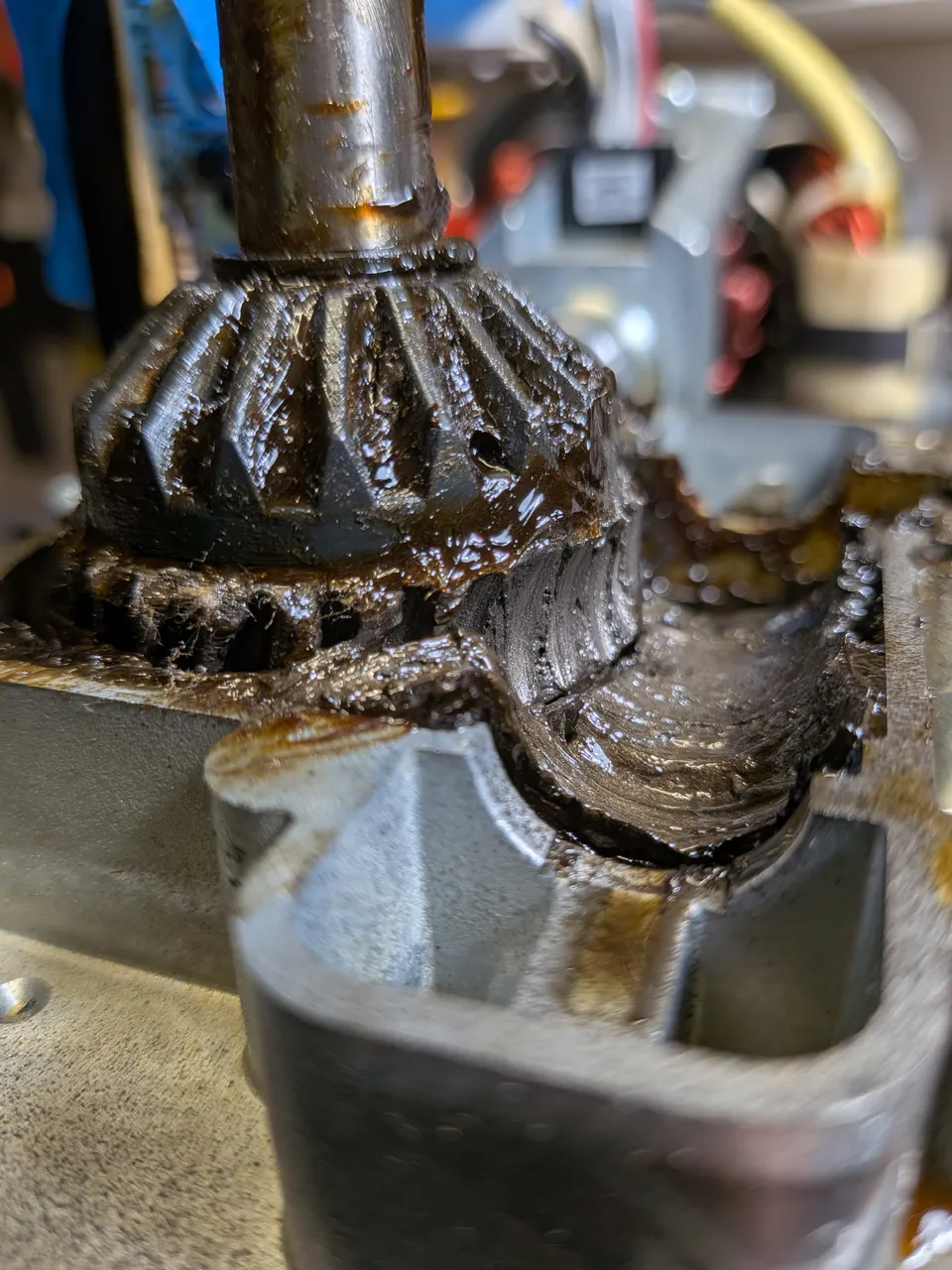
Why the beater stops while the motor keeps going
The motor sits in the back of the mixer. Its spin reaches the head through a worm gear, and from there it drives both the front attachment hub and the planetary that turns the beater. The worm gear is the weak link on purpose. It is the sacrificial part, made to strip its teeth before a jammed load can burn out the motor.
Once those teeth are gone, the motor spins freely and neither the hub nor the beater gets any drive. If only the beater has stopped, the break is likely further along, in the planetary or the pin that holds it to its shaft.
What it usually sounds and feels like
- The motor whirs normally, but the beater does not turn, or turns slowly and stops under any load
- It stopped mid-batch, often part way through a bread or cookie dough
- There was a click, a crunch or a few seconds of grinding just before it stopped (see grinding noise)
- The beater turns freely by hand with the mixer unplugged, with none of the usual resistance
- A little oil or dark grease has shown up around the beater shaft (see leaking oil)
How to tell if it is the worm gear
The front attachment hub, where the pasta roller or grinder fits, gets its drive after the worm gear, as the beater does. Checking whether the hub still turns narrows down the fault in about a minute. Keep fingers and tools out of the socket.
- Unplug the mixer and remove the beater and bowl.
- Open the attachment hub cover at the front and look at the square drive socket inside.
- Plug the mixer in, switch it to speed 1 for a few seconds and watch the socket.
- Switch it off and unplug it, then compare what you saw with the results below.
- The motor runs, but neither the socket nor the beater shaft turns: most likely the worm gear, which is the $175 full tune-up.
- The socket turns, but the beater shaft does not: more likely the planetary or its pin. Book the $40 diagnostic and I will quote the fix.
- The motor only hums: it may be jammed or have an electrical fault. Do not run it again. Book the diagnostic.
- The motor is silent: most likely an electrical fault.
If the mixer is completely silent
A mixer that does nothing at all, no hum and no movement, is a different problem. The usual causes are a damaged power cord, a worn switch or a failed speed controller. A mixer that only runs at one speed, or will not switch off, is the speed controller too. If you are not sure which you have, the diagnostic sorts it out, and its price is included in any repair.
What not to do
- Do not keep switching it on to see if it has fixed itself. It has not, and broken bits can do more damage inside the gearbox.
- Do not turn the speed up to try to get it moving.
- Do not put your hands near the beater shaft while it is plugged in, and do not force it round at any time.
- Do not add oil through the vents. KitchenAid does not recommend adding lubricant, and it does nothing for a stripped gear.
What the repair involves
For a stripped worm gear, the fix is my full tune-up. I strip the head down, fit a new worm gear, replace the gasket and clean out every trace of the old grease, because the broken teeth and metal dust are now mixed through it. Then the gearbox is packed with fresh food-grade grease, reassembled and test run under load before it comes back to you, usually in 2 to 3 business days.
It is $175 on any KitchenAid, whether a tilt-head such as an Artisan or Classic or a bowl-lift such as a Professional 600, and it is covered for 90 days on the parts and the work.
If I open it up and find more than a worm gear, I call you with the price before doing anything else.
Why it happened, and stopping it happening again
Common causes of a stripped worm gear are kneading dough above speed 2, batches bigger than the mixer is rated for, and grease that has hardened with age and stopped protecting the gears.
After the repair, keep dough on speed 2, split dense batches in two, and let the mixer cool between heavy jobs. My one-page care guide has the rest.
Is it worth it on an old mixer?
Almost always. A stripped gear on a 20 or 30-year-old KitchenAid is very repairable, and the machine underneath is usually better built than a new one at the same price. The serial number decoder tells you how old yours is, and this guide walks through the decision.
The repair for this
Full tune-up: re-grease, gasket and worm gear replacement
$175 any mixer
Confirmed before any work starts, and usually back in 2 to 3 business days. Pick up and drop off is $20 in Vaughan, Kleinburg and King City.
Related repairs
- Diagnostics$40 any mixer
- Speed controller replacement$125 tilt-head · $150 bowl-lift
- Power cord replacement$70 tilt-head · $95 bowl-lift